Before John’s Time

In the topic of ‘The Four Empires’, we see in the book of Daniel a revelation of the four empires that would lead up to the end-times. However, God made clear that these kingdoms will ultimately give way to God’s eternal kingdom.
In Daniel 2:44, Daniel told Nebuchadnezzar that God will put an end to the four kingdoms. He will then set up a kingdom that will never be destroyed but will endure forever.
In Daniel 7:13-14, Daniel saw in his own vision that it is One, like the son of man, that was given the dominion of the eternal kingdom.
In this passage, Revelation 12:1-5, we are given insight into one, who has the diabolical objective of foiling God’s establishment of His eternal kingdom.
The writer of Revelation, whom we recognize as John, the beloved disciple of Jesus, wrote down the visions which the Lord gave him.
Here John tells us that he saw two great signs.
The Woman
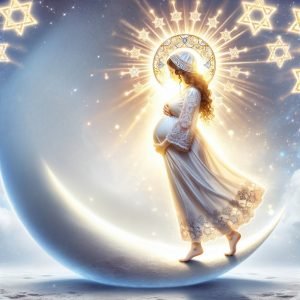
In Revelation 12:1, we have a woman adorned with the celestial bodies. She was clothed with the sun. The moon was under her feet. On her head was a crown of twelve stars.
Such adornments link her to the dream of Joseph. When Joseph’s father, Jacob, heard the dream his son narrated, he understood that the sun and moon and eleven stars referred to him, his wife and the eleven other children. So this sign John saw, probably speaks of the nation, Israel.
The identity of the woman is affirmed by Revelation 12:6 which speaks of the woman fleeing into the wilderness. She is nourished there for 1,260 days. This is an end-times event which is discussed under the topic ‘Israel Flees’.
The woman has been taken by some to be Mary. However, the fact that John refers to her fleeing into the wilderness, establishes her identity as Israel.
The Male Child
Revelation 12:2 says the woman is with child and is in labour pains.
Revelation 12:5 tells us that this child is to rule all the nations with a rod of iron. Psalm 2, most probably written by David, speaks of the King/Son who is given the nations as His inheritance.
This psalm has been understood as referring to Jesus as the King/Son. In this psalm, we see that the King will wield a rod of iron against the nations.
Psalm 2:9 (NASV) says, ‘You shall break them with a rod of iron, You shall shatter them like earthenware.’
Revelation 19:11-16 tell of the return of Christ. In verse 15, it is mentioned that He will rule the nations with a rod of iron.
So when Revelation 12:5 says the child is to rule all nations with a rod of iron, this points to the child as Christ. The sign speaks of Jesus incarnating in the nation of Israel.
Psalm 2:1-3 speak of the plot of the nations against the Lord and His anointed. The nations foolishly seek to perpetuate their own rule. They conspire against the plan of the Lord to establish His King on Mount Zion.
Psalm 2 speaks in tandem with the prophecies in the Book of Daniel concerning the four empires. The empires of man will be brought to an end. Jesus will come and establish His rule on Mount Zion. His rule will subsequently be perpetuated into eternity.
The labour pain that the woman experiences probably speak of the trials that Israel endured unto the coming of Jesus.
In the topic on ‘The Four Empires’, we see that Daniel 11:28 tells us that the Seleucid King (Antiochus Epiphanes) would have his heart set against the holy covenant. Daniel 11:33-35 warned that the people (of Israel) will fall by sword, by flame, by captivity and plunder for many days. This is probably during the time when Israel was involved in conflicts with the Seleucid kingdom, during and immediately after the time of Antiochus Epiphanes.
In history, we see that in 168 B.C., Antiochus Epiphanes desecrated the Temple and sought to forbid the Jews from practicing their religion. The family of the Maccabees led a revolt against the Seleucid Empire’s attempt to force the Jews to forsake their religion.
They were successful in resisting the efforts of the Seleucid kings in this matter. In 164 B.C. they entered Jerusalem and cleansed the Temple. We noted how the Temple was desecrated, through the activities of Antiochus Epiphanes, under the topic ‘The Four Empires’.
In 142 B.C., Simon Thassi, a member of the Maccabee family, became High Priest and ethnarch of Israel. This was considered as the start of the Hasmonean dynasty. Judea then maintained a semi-independent status within the Seleucid kingdom. The Seleucid kings continued their attempts to bring Judea under their subjection. However, they did not attempt again to force the Jews to give up their religion.
The Seleucid kingdom was at this time in decline. By 63 B.C., what was left of the kingdom, was annexed by the Roman general, Pompey and incorporated as the Roman province of Syria.
At this time, there was a tussle between the descendants of the Maccabees for the position of king and high priest of Judea. Aristobulus II had seized power from his older brother, John Hycanus II. They sought the intervention of Pompey in their contest. Pompey invaded Jerusalem and displaced Aristobulus. He installed John Hyrcanus as high priest and ethnarch of Judea. Judea became a protectorate of Rome. It was placed under the Roman province of Syria and had a Roman governor.
It was noted that Pompey entered the Holy of Holies but the Temple was subsequently cleansed.
In 40 B.C., the son of Aristobulus II, Antigonus II, with the aid of a Parthian army invaded Palestine. The Jewish population rose in support of him for they considered that John Hyrcanus was a puppet king. He had been aligning himself with Antipater, an Idumaean who had been made procurator of Judea by the Romans.
Antipater had died in 43 B.C. but he had placed his two sons as governors. Herod was governor of Galilee and his elder brother Phasael was governor of Jerusalem.
John Hyrcanus II and Phasael were captured by the Parthians. Antigonus had the ears of his uncle cut off so that he could no longer be high priest. Phasael was said to have taken his own life. Antigonus became king and high priest of Judea.
However, Herod had escaped to Rome. He received the support of the Romans and led an army to capture Jerusalem. He successfully captured the city around 37 B.C. Antigonus was captured by the Romans and executed.
In such a setting, the male child was born sometime around 1 B.C.
Israel had in this time transitioned from faith to a law of works.
As Paul said in Romans 10:2-3 (NASV), “For I testify about them that they have a zeal for God, but not in accordance with knowledge. For not knowing about God’s righteousness and seeking to establish their own, they did not subject themselves to the righteousness of God.”
So we read in John 1:11 (NASV), “He came to His own, and His own people did not accept Him.”
But God had, through all the struggles that Israel encountered, refined a people for Himself.
Luke 1:30-33 (NASV) says, “And the angel said to her, “Do not be afraid Mary, for you have found favor with God. And behold, you will conceive in your womb and give birth to a son, and you shall name Him Jesus. He shall be great and will be called the Son of the Most High; and the Lord God will give Him the throne of His father David; and He will reign over the house of Jacob forever, and His kingdom will have no end.”
John, the forerunner of the Messiah was born to a godly couple of priestly descent. The birth of the Messiah were announced to lowly shepherds. When the baby was brought to the Temple, he was greeted with joy by Simeon and Anna. The Lord was able to call to Himself His band of disciples in His time here on the earth.
Revelation 12:5 also tells us that the child was caught up to God and to His throne. It indicates that He was saved from the intention of the dragon.
The sign does not relate what Jesus accomplished here on earth. It only indicates His incarnation and ascension to God and to His throne.
The Great Red Dragon
In Revelations 12:3, John writes of seeing another sign in heaven. It is of a great red dragon. This dragon has seven heads and tens horns. On his heads are seven diadems.
The identity of the dragon is given to us in Revelations 12:9. In this verse we see the other terms which are used to identify him, which are, serpent of old, devil and Satan.
The description of the dragon is similar to the description of the ‘beast’ in Revelations 13:1 (NASV),
“And the dragon stood on the sand of the seashore. Then I saw a ‘beast’ coming up out of the sea, having ten horns and seven heads, and on his horns were ten crowns, and on his heads were blasphemous names.”
An angel gave John an explanation of the ‘beast’ in Revelations 17. In Revelations 17:9-10 (NASV), the angel says of the ‘beast’, “Here is the mind which has wisdom. The seven heads are seven mountains upon which the woman sits, and they are seven kings; five have fallen, one is, the other has not yet come; and when he comes, he must remain a little while.”
We are reading an explanation of the ‘beast’ and relating it to the dragon. The picture of the ‘beast’ probably shows how Satan operates through different times in history to execute his purpose.
A total of seven kings appear on and off in historical time. The five who have fallen would refer to the kings who had ruled in the past before John’s time. The one who ‘is’ would refer to the king ruling at John’s time. The other who ‘has not yet come’ would refer to a future king.
At different times in history, the king who is in power is a nascent ‘beast’. He is there in his time, as the agent of Satan. By John’s time, five had already come and gone. The king in John’s time was one of them. After John’s time, there would come another.
One of the kings ‘who had fallen’ would probably be Antiochus Epiphanes. As we see in the topic, ‘The Four Empires’, Daniel indicates his activities. History identified him as entering and desecrating the Temple in Jerusalem. His actions provide a picture of what Jesus referred to as the setting up the Abomination of Desolation, which would occur when the end-time ‘beast’ appears.
If we accept that Revelation was written around A.D. 95-96, the one ‘who is’, at the time of John, would be the Emperor Domitian. He is the sixth king. He sought to portray himself as a god and persecuted the Christians for their faith.
The one ‘who has not yet come’ would be one who comes after the time of John. He would be the seventh king.
Revelation 17:12 tells us that the ten horns are ten kings who will receive authority as kings together with the ‘beast’. Their purpose is to give their power the the ‘beast’.
Satan works through his agents.
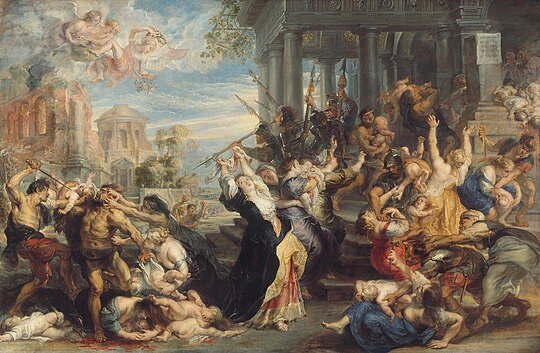
John saw in his vision that the dragon was waiting to devour the child. This reveals Satan’s efforts to oppose God and His plan in killing the Messiah.
We could see his intention in the attempt by King Herod to kill the one whom the wise men inquired about in Jerusalem. Matthew gave us the account of this event. He also related this event to the prophecy in Jeremiah 31:15b (NASV) which says, “A voice is heard in Ramah, lamenting and bitter weeping. Rachel is weeping for her children; she refuses to be comforted for her children, because they are no more.”
However, Matthew tells us that the Lord had told Joseph to bring the child down to Egypt to escape the intent of Herod.
This incident might inform us that one of the seven heads of the dragon and of the ‘beast’ would refer to King Herod. Satan sought to devour the Child when the Child was born. However, his effort to do so was probably in instigating King Herod to have the Child killed through a massacre of children.